
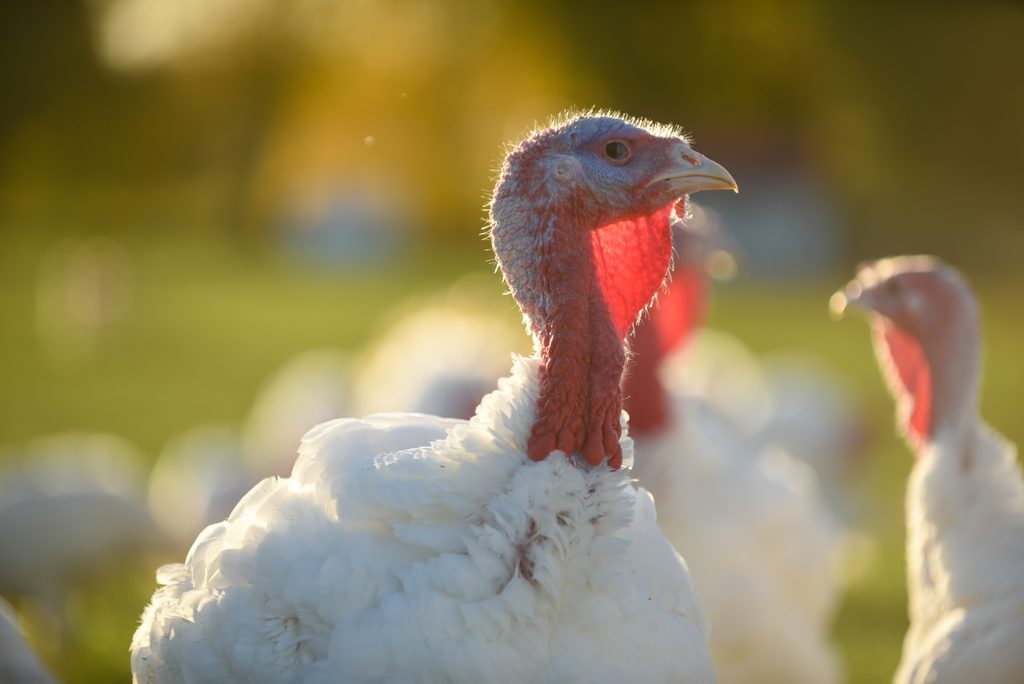
There was a time when Turkey Days were one of the most stressful events we held all year.
Which is funny, because today they’re one of my favorites.
For years, we took reservations for our fresh Thanksgiving turkeys. On the surface, that sounds like the most logical way to do it: you tell us roughly what size turkey you want, we raise your turkey, and a few months later you come pick it up. It even gives us a cash boost to be able to weather the long growing period of raising turkeys.
Easy, right?
Except there is one tiny problem. Turkeys are living things. And living things are notoriously bad at reading spreadsheets. Lol.
You Can’t Order a Turkey to Grow to 16.4 Pounds
When we put poults on pasture in the spring, I can make educated predictions about how they’ll grow.
I can choose genetics. I can formulate their feed. I can manage pasture, health, timing and processing dates. After doing this for years, I can get pretty dang good at estimating where we’ll end up.
But I cannot look at a poult and say, “Okay, little buddy, Susan requested a 16-pound Thanksgiving turkey, so please govern yourself accordingly.”
Within the same group, some birds simply grow faster than others. Cooler weather can yield smaller birds as they spend a lot of energy just keeping their body temps up. Warm weather can yield larger birds as they thrive in that 70-80 degree mark. This year? We had an unusually warm and dry summer and the birds? Well, they grew really well. They’re big.
When you’re raising a few hundred turkeys instead of millions of them, that natural variation matters and makes it really hard to predict.
One year it mattered so much that I ended up sitting on my shower floor crying. Our birds were WAY bigger than I had planned for. And it looks like it happened again this year.
We had customers expecting one thing, living animals that had produced another, and me feeling like I had somehow failed everyone involved.
Looking back, I can laugh about it but I’m still a bit traumatized. I assure you I was NOT laughing on the shower floor that fall.
The Grocery Store Has Changed What We Expect
Part of what makes this difficult to explain is that most of us have been trained by the modern food system to expect incredible consistency & perfection, an expectation that small farms deeply struggle with.
Walk into a grocery store looking for a Thanksgiving turkey and you’ll likely find birds neatly sorted into different weight ranges (and often priced far below production value as a loss leader but that’s a whole other topic). That makes it feel like turkey farmers can simply produce the size they need. Commercial turkey production is a little more complicated than that.
The United States raises turkeys on an enormous scale. USDA reported 200 million turkeys raised in 2024 alone. At that scale, the industry doesn’t need every bird to become the exact same product. Different birds have different destinations.
The National Turkey Federation explains that commercial hens are typically processed at around 14 weeks and about 15.5 pounds and are commonly sold as whole birds. Toms are grown longer and considerably larger—around 38 pounds in their example—and are frequently further processed into things like cutlets, tenderloins, sausage, deli meat and other turkey products with a higher value.
USDA’s own turkey market reporting reflects different whole-bird weight categories, including 8–16 pound hens and 16–24 pound toms.
And the turkey industry has grown far beyond Thanksgiving dinner. What was once largely a seasonal whole-bird business has evolved into a year-round industry producing ground turkey, breasts, deli meats, cutlets, sausage and countless other products. That’s an incredibly important difference.
If you’re producing millions of pounds of turkey with multiple processing and sales channels, a bird that doesn’t fit one particular whole-bird specification can potentially become something else. We don’t have that luxury.
We Have One Sales Channel: You
We’re raising hundreds of turkeys. And we’re raising them for one very specific purpose: Your holiday table.
We aren’t sending our oversized birds to a deli-meat line. We aren’t diverting smaller birds into another national product category. We aren’t combining meat from thousands of birds into ground turkey or shipping different sizes into different markets across the country.
Our turkeys are raised here, processed here, sold here and leave our farm ready for your table. That’s it.
Which means the natural variation that becomes relatively easy to manage across an enormous food system becomes a VERY real logistical challenge on a small farm. Especially when you’ve promised individual people individual sizes months before those turkeys have finished growing. It becomes a logistical nightmare.
So We Stopped Taking Reservations
This was a surprisingly hard decision. Customers LOVE reservations & I understand why. Thanksgiving is high stakes. Nobody wants to discover three days before Thanksgiving that they don’t have a turkey.
But reservations created an enormous amount of work & stress behind the scenes. Once the birds were processed, every turkey had to be inventoried. Then we had to start playing an enormous game of turkey Tetris:
Who requested 14–16 pounds?
Do we have enough?
Can this 17-pound bird go to someone who requested 16? Will they be ok spending more $?
What happens when most of the flock finishes heavier than predicted?
What happens when someone doesn’t show up?
What happens when someone reserved an 18-pound bird 4 months ago but arrives and decides they actually want a 14-pounder?
Multiply that by hundreds of birds.
Suddenly something that sounded incredibly convenient had created an enormous amount of administrative work, sorting, labeling, customer communication and my worst nightmare in an already high stakes job, stress. And all of that labor costs money.
So eventually, we asked ourselves a very simple question: What if we just…stopped?
And Something Funny Happened
Turkey Days got less stressful. (We’ve also gotten much better at raising turkeys.)
After years of adjusting genetics, timing, management and the number of birds we raise, we’ve dialed our production in enough that we can now offer a really solid range.
This year, we’re expecting the majority of our turkeys to fall between approximately 16 and 20 pounds.
Instead of promising specific weights months in advance, we raise enough birds to give our community a good selection. Then we open the doors. You come in, look at what’s available and you pick your turkey.
First come, first served.
Is it quite as convenient as clicking “reserve” six months before Thanksgiving? Probably not. But it has allowed us to remove an enormous amount of unnecessary labor and administrative cost while putting our energy where we’d much rather put it: raising really good turkeys.
Welcome to Turkey Days
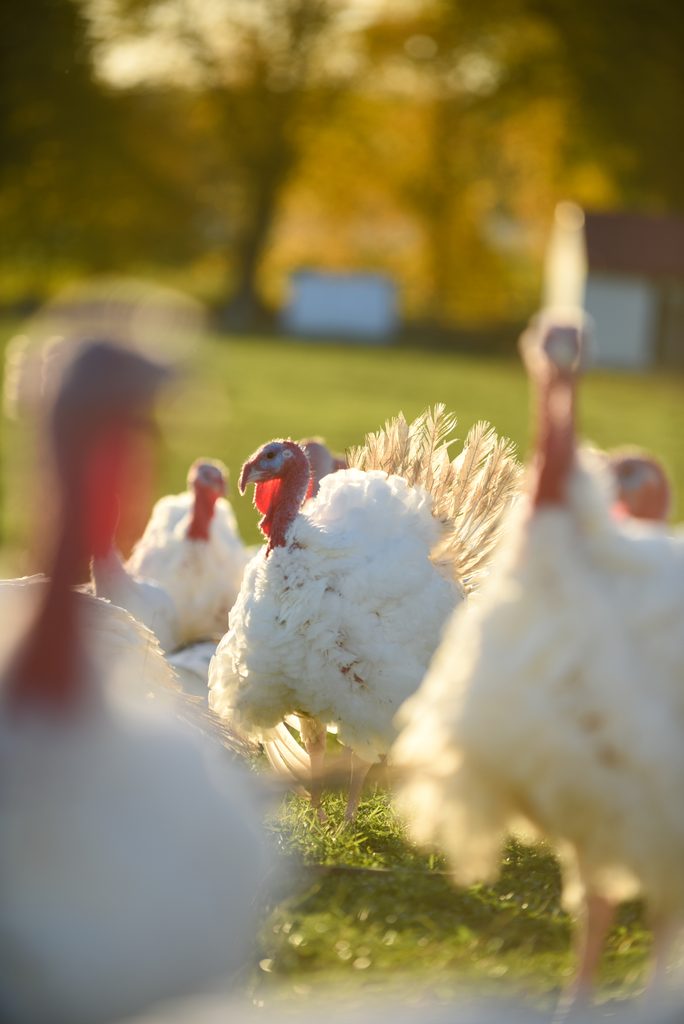
There is something else I’ve grown to love about this system. Turkey Day actually feels like an event now.
Doors open at 10 AM, and there will probably already be a line. Hundreds of birds will leave this farm over two Saturdays, headed for Thanksgiving tables throughout our community. It is what I lovingly refer to as coordinated chaos.
Whenever I’m doing something high-stakes with my kids, I remind them to put on their “patience pants.” Turkey Day is your opportunity to wear yours. 😂
Grab yourself a coffee on the way. Dress warmly. Come early. Chat with the person standing next to you. And please don’t wait until the end of the day.
These turkeys WILL sell out.
Because for all the spreadsheets, feed calculations, pasture moves, processing days, weight predictions and occasional shower-floor meltdowns that go into raising them, Turkey Day ultimately comes down to something remarkably simple: We raised food.
Our community showed up to buy it. And a few weeks from now, families will sit down for Thanksgiving dinner with a turkey in the middle of the table that was raised right here on our farm.
I can’t think of a better ending to the season.
Also, stick with us because this year, we have storage space in our freezer to offer a few birds online, too. Not local? I think we might actually be able to get a bird on your table this year!




PLEASE COMMENT BELOW