Buckle up, friend. This is a long but a good one. If you’ve shopped for pasture-raised eggs or chicken lately, you’ve probably seen the label corn & soy free.
It sounds simple enough, and for many people it feels like an obvious upgrade. If corn and soy are ingredients you try to avoid in your own diet, it makes sense to look for poultry raised without them too.
But when it comes to feeding chickens, nothing is ever quite that simple.
Every feed ration has to be balanced for energy, protein, vitamins, and minerals. You can’t just remove ingredients without replacing the nutrition they provided. So when a label says corn & soy free, the real question isn’t only what was taken out, it’s also what was put in its place.
Once you start looking at that part, the conversation gets a lot more complicated than the carton makes it sound.
You Can’t Just Remove Ingredients. You Have to Replace Them.
Corn is primarily a carbohydrate source in poultry feed. Soy is one of the main protein sources.
Chickens need both energy and protein to grow properly and to lay eggs consistently, so when corn or soy are removed, something else has to supply those nutrients.
There isn’t a magic ingredient that does the exact same job. Feed mills have to build a new ration using other grains, seed meals, animal proteins, or plant proteins to keep the birds healthy.
And every one of those alternatives comes with its own trade-offs.
What Our Birds Actually Eat
One piece of the conversation that often gets missed when people focus on feed ingredients is that for truly pasture-raised poultry, the feed ration is only part of the diet.
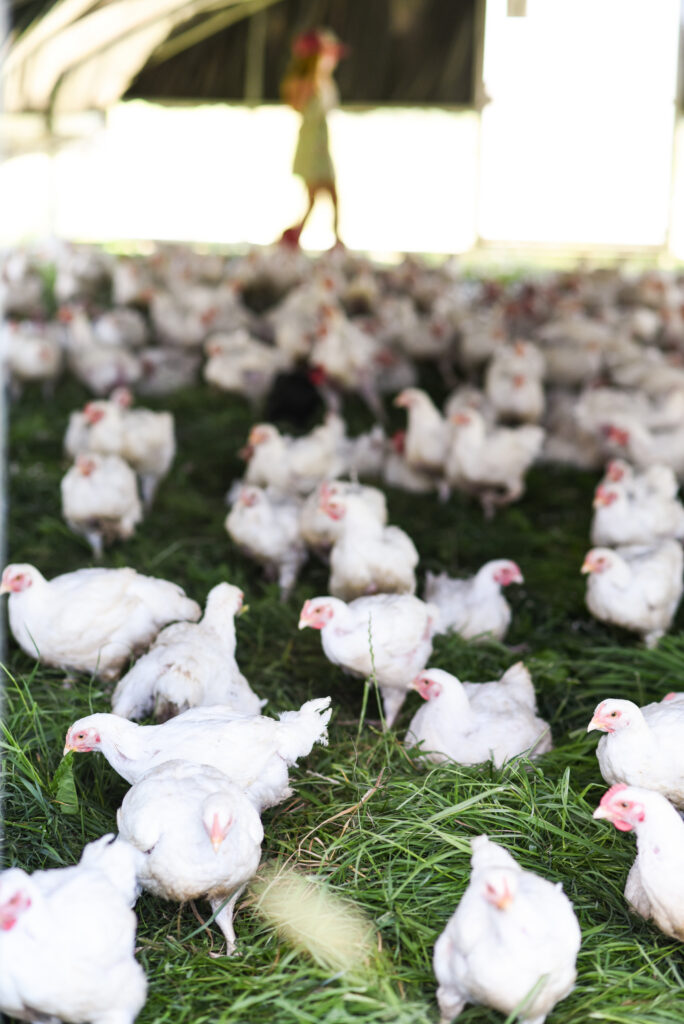
During the grazing season, our chickens are moved to fresh pasture every single day. Those pastures are built on clover-based forage mixes that provide a wide variety of grasses, legumes, seeds, and insects for the birds to eat naturally.
At minimum, we estimate that around 40% or more of our chickens’ diet comes directly from pasture during the months they are outside.
That means a significant portion of what they are eating isn’t coming from the feed bin at all.
It’s coming from fresh forage, bugs, seeds, and living plants growing in healthy soil.
Yes, our ration still contains corn and soy. We made that decision intentionally because it allows us to use organic feed sourced from the U.S. and Canada that we can verify and stand behind.
But the daily rotations are what really shape the diet.
Because the birds are moved every day, the majority of what they consume over the course of the season is not coming from monocropped grain fields. It’s coming from diverse pasture that is actively growing, being grazed, and then allowed to rest and recover.
That difference matters for the health of the birds, the health of the soil, and the nutritional quality of the eggs and meat they produce.
And it’s also why we believe looking at a single ingredient on a label rarely tells the whole story.
The Omega-6 vs Omega-3 Conversation
A lot of the recent discussion around corn and soy in poultry feed started because of concerns about fatty acids, especially the balance between omega-6 and omega-3.
You may have seen articles or social media posts pointing out that eggs from chickens fed corn and soy tend to be higher in omega-6 fatty acids compared to omega-3s. That part isn’t surprising. The fatty acid profile of eggs reflects what the birds eat, and both corn and soy contain higher levels of omega-6.
Because of that, some brands have come under scrutiny for using corn and soy in their feed, even when the birds are pasture raised.
But removing corn and soy doesn’t automatically mean the fatty acid balance improves.
When those ingredients are taken out, they have to be replaced with other energy and protein sources, and many of those alternatives, like canola meal, other oilseed byproducts, or certain plant proteins, also contain significant amounts of omega-6 fatty acids.
In other words, the omega-6 level in eggs isn’t controlled by one ingredient. It’s influenced by the entire ration, along with how much the birds are actually eating from pasture.
Fresh forage, grasses, clover, and insects are some of the biggest contributors to higher omega-3 levels in pasture-raised eggs, which is one reason birds that spend more time grazing often produce eggs with a different fatty acid profile than birds raised indoors.
This is why the conversation is more complicated than simply saying corn and soy are bad, or corn-and-soy-free is better.
What Corn Is Often Replaced With
In many corn-free rations, corn is replaced with other grains or seed byproducts to supply carbohydrates.
One ingredient we commonly see used is canola meal, which is a byproduct of the seed oil refining process. After oil is extracted from the seed, the remaining meal is used in livestock feed because it still contains usable protein and energy.
Another factor many people don’t realize is that the majority of canola grown in the United States is a genetically modified, herbicide-tolerant crop, often referred to as Roundup Ready. This allows the crop to be sprayed for weed control without damaging the plant itself.
That doesn’t automatically make it unsafe, but it does show that corn free does not always mean less processed, less conventional, or more natural.
In some cases, removing corn actually requires using more specialized ingredients to keep the feed nutritionally balanced. Millet is another alternative for corn free rations and it nutrition profile still contains high levels of Omega-6 fatty acids most people on the corn free trend are trying to avoid.
Like most things in farming, the label only tells part of the story.
What Soy Is Often Replaced With
Soybeans are one of the most efficient protein sources available for poultry. Chickens need a high level of protein to grow properly and to produce eggs, so when soy is removed from the diet, that protein has to be replaced with something else.
One common replacement is fish meal.
Fish meal is made by cooking, drying, and grinding fish or fish byproducts into a high-protein ingredient used in livestock, poultry, and aquaculture feed. It has been used for decades because it provides a very concentrated source of protein along with important minerals birds need for growth and egg production.
Nutritionally, fish meal works very well for chickens.
The bigger question for many farmers isn’t what it is — it’s where it comes from and how it’s produced.
Where Fish Meal Comes From — And Why That Matters
A large portion of the fish meal used in livestock feed worldwide comes from large commercial fisheries and aquaculture systems.
Some fish meal is made from wild-caught fish processed specifically for this purpose, and some comes from byproducts left over after fish are processed for human consumption. But a significant amount comes from large-scale operations that produce fish meal for global feed markets.
Another part of the conversation that rarely gets talked about is what the fish themselves are fed before they ever become fish meal.
Farmed fish are typically raised on formulated rations designed for fast growth and efficiency, very similar to other livestock species. Those rations can include ingredients like corn, soy, wheat, seed oils, and other processed feed components — the same types of ingredients many consumers are trying to avoid when they look for corn & soy free poultry products.
Wild-caught fish generally cannot be certified organic under U.S. standards because the production environment can’t be controlled the way organic rules require. Because of that, fish meal used in organic feed often comes through large commercial fisheries or international supply chains, and it may be certified through foreign organic programs that are recognized by USDA.
That doesn’t mean the ingredient is unsafe, but it can make it harder for farmers like us to personally verify exactly how it was produced compared to feed sourced domestically.
By the time fish meal makes its way into a poultry ration, the ingredient has already gone through multiple production systems, often in different countries, under different standards, and with different levels of oversight.
That’s why a simple label like corn & soy free doesn’t always tell the whole story.
Other Soy Alternatives — Including Peas
Another ingredient often used to replace soy in poultry feed is field peas.
Peas can provide a good source of plant protein, which makes them a logical option when feed mills are trying to formulate a soy-free ration. They are commonly used in both organic and specialty feeds, and on paper they sound like a simple, natural alternative.
But like most things in agriculture, the reality is more complicated.
Peas are typically grown as a large-scale commodity crop, and in many areas they are produced in monocropping systems where the same fields are planted year after year. Those systems often require intensive tillage and can leave soil exposed for long periods of time if they aren’t managed carefully.
My dad actually worked as a mechanic for a large pea harvesting company when he was younger, so I grew up hearing firsthand what those harvest seasons looked like. Huge equipment, huge acreage, and a lot of ground getting turned over in a short amount of time.
That doesn’t mean peas are a bad crop (I love eating peas myself) but it does mean that using them in feed doesn’t automatically make the system more environmentally friendly than using organic soy grown in a well-managed rotation.
Once again, every ingredient has trade-offs, and the label on the carton rarely explains what those trade-offs actually are.
Why We Choose to Source U.S. or Canadian Organic Feed
After looking at all the different ways poultry feed can be formulated — corn & soy free, fish meal, peas, seed meals, imported ingredients — we realized pretty quickly that there isn’t a perfect option.
Every feed program involves trade-offs, and every ingredient has a story behind it.
For us, one of the biggest priorities became knowing where the feed actually comes from.
That’s why we choose to source organic feed ingredients from the United States and Canada whenever possible.
Organic certification in North America follows a defined standard with inspections, documentation requirements, and traceability that we can verify through the mills we work with. That doesn’t mean the system is perfect, but it does give us a level of transparency that is harder to guarantee when ingredients are coming from overseas supply chains.
Because we raise our birds here, process them here, and sell directly to our customers, it matters to us that the feed is something we can stand behind as well.
That doesn’t always mean choosing the trendiest ration, and it doesn’t always mean following the newest marketing label.
Sometimes it just means choosing the option we can verify, understand, and feel confident feeding to our own family.
Transparency Over Trends
This whole rabbit hole started because of recent articles and fast-moving social media posts questioning why some pasture-raised brands still use corn and soy in their feed.
And I understand why people ask those questions. I ask the same ones.
But the more I dig into feed formulation, the more I realize that simple labels rarely tell the whole story.
Removing corn means replacing the energy with something else.
Removing soy means replacing the protein with something else.
And those replacements can include things like seed meals, imported fish meal, or large-scale commodity crops, all of which have their own environmental impact, sourcing challenges, and transparency questions that really undermines our customers desire to source a transparent protein for their freezer.
That doesn’t make those feeds wrong. It just means the label alone doesn’t tell the whole story.
For us, the more we looked into it, the more we realized that chasing the trend didn’t necessarily get us closer to the kind of farming we believe in.
I need to know where the feed comes from. I need to know how it was grown. I need to know that the standards behind the label are something I can actually verify, not just something printed on a tag.
That’s why we choose to use organic feed sourced from the U.S. and Canada, even though it still contains corn and soy.
It may not check every marketing box, and it may not follow every current food trend, but it’s the program that makes the most sense for our farm, our animals, and our customers.
At the end of the day, I’ll choose transparency over trends every time, even if that means our labels aren’t the flashiest ones in the freezer case.
The Reality of Feed Cost at Scale
There are companies out there doing an incredible job sourcing truly corn- and soy-free feed ingredients, and I want to be clear about that. It can absolutely be done, and there are farms committed to using those rations.
We’ve looked into them ourselves.
The challenge for us hasn’t been whether those feeds exist, it’s whether they make sense for our farm at the scale we raise birds.
Some of the best-sourced corn- and soy-free rations we’ve priced out cost two to three times more per ton than the custom made, quality sourced organic feed we currently use. When you’re feeding a handful of chickens, that difference might not matter much. When you’re feeding thousands of birds every day, the cost adds up very quickly.
Feed is one of the largest expenses in raising poultry, and even small increases in price per pound can make the final cost of eggs or chicken climb fast.
We have to balance a lot of things at the same time:
- the quality of the ingredients
- where the feed comes from
- how the birds are raised
- what the final product will cost for our customers
We could switch to a ration that checks every box on paper, but the reality is that it would push our prices to a level that many families simply couldn’t afford.
That doesn’t mean those feeds are wrong, and it doesn’t mean farms using them are doing anything differently than we are or aren’t seeking transparency in their feed.
It just means every farm has to make decisions based on their scale, their customers, and what they can realistically sustain long-term.
For us, we chose to invest in daily pasture rotation, locally sourced organic feed, and a system we can verify and stand behind, even if that means our ration still includes corn and soy.



PLEASE COMMENT BELOW